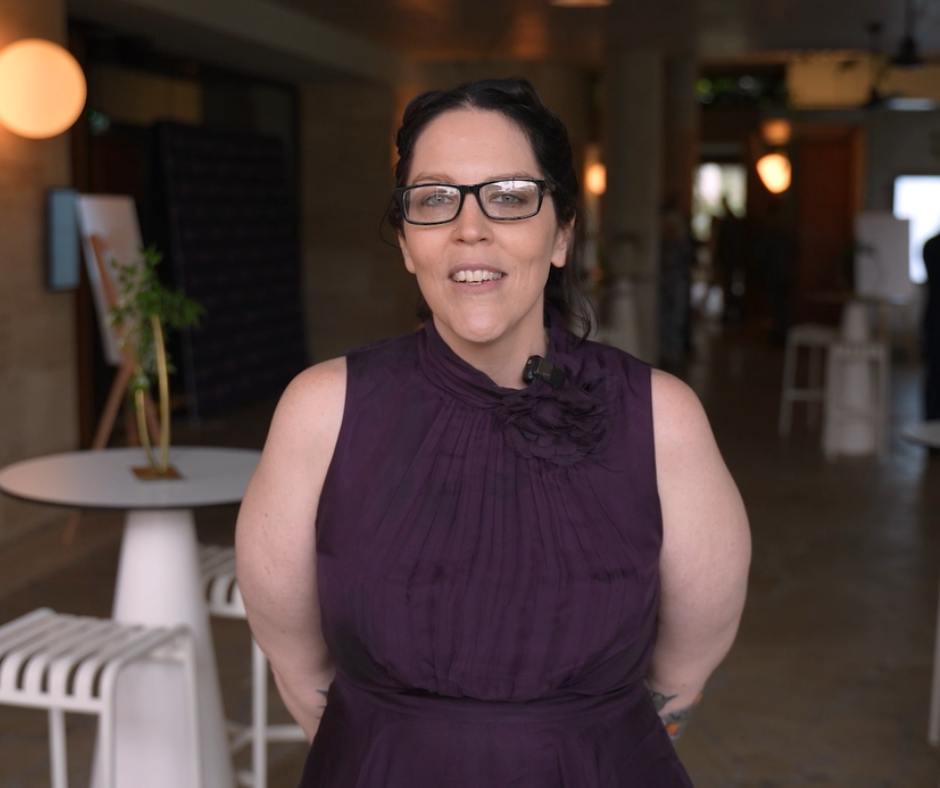
Blindsided by cancer: how Bec Allingham faced the unthinkable.
Bec was in the best shape of her life and set to celebrate her 40th birthday on Hamilton Island with 30 of her closest friends and family when she was diagnosed with cervical cancer.
Blindsided by cancer: how Bec Allingham faced the unthinkable
“You’ve got to be kidding me!” was Bec Allingham’s immediate reaction to hearing the words, “it is cancer.” Bec was in the best shape of her life and set to celebrate her 40th birthday on Hamilton Island with 30 of her closest friends and family when she was diagnosed with cervical cancer. She endured a gruelling path, relying on the compassion and resilience of the cancer community to persevere.
The unthinkable news
“I always thought that if you looked after yourself, you’d be fine,” Bec said. “Cancer was never on my radar. I didn’t have any family history or know anyone with cancer.”
A few months before her diagnosis in 2024, Bec had started a construction and administration consultancy, drawing on years of experience working for a family business. She and her husband, Tristan, had decided after several miscarriages that children were not in their plans. They were focusing on their business and fit, healthy lifestyle when life threw a spanner in the works.
Symptoms and early investigations
In 2024, Bec twice experienced unusual bleeding. Following a friend’s advice, she went to her GP, who performed a cervical screening test. When the test came back positive for HPV16, the GP referred her to a gynaecologist.
“The gynaecologist saw a small growth, which he thought was most likely a fibroid, and performed a LETZ procedure to remove the abnormal cells from my cervix,” Bec explained. “He was so nonchalant that I didn’t expect anything significant. A few days later, when he called with the results to tell me that it was cancer, I was blindsided. He asked me to let him know which gynaecologist oncologist I wanted a referral to, and I had no idea.”
Seeking answers
Thankfully, Bec had a nursing friend whom she called for advice. She connected Bec quickly with Professor Andreas Obermair.
“Professor Obermair was overseas at the time, but he ordered all the tests – PET scan, MRI, etc, – so when I went to see him, he had all the results ready,” Bec said. “On one hand, I was lucky because the previous procedure had removed the original tumour, but I had a questionable lymph node and a growth on my liver.”
“I never knew much about cancer, but I knew there were four stages. When I heard I had Stage 3C1, I cried. I knew it wasn’t good. What I have learnt since is that there is so much more to it than a number – that number classifies you in a medical group, but your outcome is not going to be the same as everyone else with that classification.”
“A few weeks after my first appointment with Professor Obermair, I celebrated my birthday on Hamilton Island,” Bec said. “I knew I would soon return for surgery to remove my lymph node, though I still did not know whether I had liver cancer.”
Undergoing treatment
When the treatment began, Bec’s surgical and scan results were mixed. The MRI revealed the growth on her liver was not cancer, but the lymph node Professor Obermair removed was. Bec began six rounds of chemotherapy and 28 rounds of radiotherapy.
“My experience opened my eyes to the entire system. It was so overwhelming. So many doctors, tests, scans, treatments, and then more tests,” Bec said. “On Friday, 13 December, after my first week of chemo, I fainted and was rushed to the hospital with low blood pressure. I was admitted to the oncology ward, which felt bleak. Every chemo session was terrifying as I dreaded the same outcome, even though the doctor adjusted my chemo drugs.”
“On the other hand, radiotherapy was easier at the beginning and faster, but the side effects crept up on me and steadily worsened, impacting my bladder and bowel.”
Support from all sides
After telling her family, Bec used Facebook to quickly share her diagnosis with friends. She posted the quote: “You can have a thousand problems in your life until you have a health problem. Then you only have one.”
Many friends reached out to see how they could help, but Bec found it hard to know how.
“When I’m nervous, I talk,” Bec said. “I was always the youngest patient at every treatment appointment, and I earned a reputation for sparking up a conversation with everyone. We were all in it together, so why not have a laugh to help each other through the intense times?”
At her second chemo appointment, Bec met Paula Hatchman. They hit it off immediately. Their laughter prompted their nurse, Jamie, to give them a gentle reminder to be quieter. Paula shared stories about Cherish, Everest Base Camp trek, and the Brisbane fundraising lunch.
When people asked how they could help, Bec said they could donate to Cherish. “Many of the tradespeople I work with were grateful to have a respectful way to help, without invading my privacy. I bought a table for the Brisbane lunch – and accidentally raised over $10,000.”
Searching for normal
Bec continued working through her treatment to preserve a sense of normality in her life.
“I am so grateful to the family business that continued to pay me a full-time wage, supporting me all through my treatment,” Bec said. “I would work on the days I had energy or take my laptop to appointments. It was a welcome distraction from treatment.”
“When my treatment was over, I thought I’d cartwheel out of there, relieved it was all over,” Bec said. “Instead, I found myself suddenly without something to do and wondering, ‘Did it work? What now?’ I also didn’t ring the bell at chemo. I almost didn’t want to leave.”
After a clear PET scan, Professor Obermair presented Bec with three options: do nothing, undergo internal radiation, or have a complete hysterectomy. Since she did not want to have children, Bec opted for surgery.
The physical and emotional toll
“Although I have had surgery before, I underestimated the massive recovery from a radical hysterectomy,” Bec said. “Even harder than dealing with the effects of medical menopause, pelvic floor and abdominal issues is living with the constant fear of possible recurrence.”
“It’s difficult going from scan to scan when your body remembers the trauma it endured. I am super organised, in control, and always planning. Living with uncertainty is exhausting. It’s easy to read something negative on social media and spiral into it. When you have been through this, you realise how quickly things can take a turn.”
Looking ahead
Bec now has an annual PET scan and is adjusting to life between checks. “I wish it had never happened. Cancer changed everything in my life, but you start living more when you know you only have one life,” Bec said. “In 2025, we redid our trip to Hamilton Island – just the two of us this time.”
“While I think I’m the luckiest of the unlucky, I’m impatient. I feel my body should be back to what it was before, even though I know it’s been through a tough year. And although all my recent scans have been clear, I still don’t want to get ahead of myself just yet.”
“Cancer teaches you lessons no one asks for: how quickly life can change; how strong fear can be; how deep resilience goes; how survival isn’t simple; how healing takes time; and how powerful love can be.”
If you would like to help fund research into cervical cancer and raise awareness that will add years to women’s lives and life to their years, please:
If you would like to ask a question about fundraising or give us some feedback, please contact us via the form and let’s chat.
Alternatively, please contact Amy Hyslop, Fundraising and Development Manager on 0483 758 808 or email fundraising@cherish.org.au
You can also direct message us on Facebook, Instagram or Twitter.
If you need professional, confidential support about a gynaecological cancer diagnosis or treatment, please call Cancer Council’s free service on 13 11 20.
Cherish Women’s Cancer Foundation | Registered as Gynaecological Cancer Foundation Ltd | ABN 86 158 553 229


Cherish Women’s Cancer Foundation © 2026 | Developed by