October 20, 2025

Fighting to have a family: feMMe Molecular
Aged 36, Tammy found out she may need a hysterectomy, shattering her dream of having a family. Tammy and her partner had been together for 16 years and tried to have children, but it never happened. They had sold their house in Tasmania and had enough money for IVF – their last chance.
“As we were going through the standard IVF checks, I had to have several polyps removed,” Tammy said. “One had atypical complex hyperplasia cells, which can lead to endometrial cancer. The standard treatment, even for early-stage cancer, was a hysterectomy, meaning everything we’d put into trying to have a child would have all been in vain.”
Tammy’s doctor referred her to the Queensland Centre for Gynaecological Cancer Research. By joining the feMMe clinical trial, Tammy received a less invasive treatment using an IUD. It gave her the chance to preserve her fertility, leaving open the possibility of having a child.
Tammy’s treatment and IVF was successful. Now Tammy and her partner have a son, Jasper, who has just turned five. Tammy is grateful to have had the opportunity to participate in feMMe. However, she knows that her story is still unusual.
“Often, when we talk about cancer treatment, we only talk about survival. But, for many people, the main concern is not whether they survive but the quality of the life they will lead,” she said. “I’ve met women who never had a choice. They had to have hysterectomies in their 30s. It’s very unfortunate, and I’m relieved we had a choice. I hope the trial I was part of leads to further study that helps other people in my position.”

Add years to her life and life to her years with Cherish
Why the feMMe trials?
More than 3,300 Australian women are diagnosed each year with endometrial cancer. It is the cancer that attacks the organ that nurtures life itself – the uterus or womb. A rising number of women are diagnosed young or have multiple severe medical conditions that increase their risk of experiencing complications during and after surgery.
While the endometrial cancer survival rate is high (83% at five years), its standard treatment is brutal. A total hysterectomy includes the removal of a woman’s womb, fallopian tubes and ovaries, and, in some cases, her lymph nodes. High-risk patients may also have chemotherapy, radiotherapy or a combination.
For younger women who want to bear children, this invasive treatment is devastating. Even women who have had children suffer.
Despite being the most common gynaecological cancer, endometrial cancer is under-researched. We critically need a risk-adjusted, personalised treatment for women with endometrial cancer.
Getting started – feMMe
During an earlier trial, our research partner, QCGC Research, found that even with laparoscopic surgery for endometrial cancer, women with larger bodies did not fare well. This discovery led to the first feMMe trial, which Cherish made possible.
feMMe aimed to treat women with early-stage endometrial cancer less invasively using the Mirena, an intra-uterine device (IUD). The research team recruited 165 women, with the last patient enrolled in April 2020. They will follow the women’s progress for up to seven years.
feMMe has identified that up to 61% of women with early-stage endometrial cancer could potentially be treated with this minimally invasive treatment and expect the same survival outcomes as the standard surgical treatment.

About feMMe Molecular
feMMe evolved into a new study – feMMe Molecular – aimed at translating the earlier findings into clinical practice. The vision of this research project is to create a new patient-centred approach – personalised treatment options for women with early-stage endometrial cancer that account for their risks and preferences. Cherish funded QCGC Research’s first post-doctoral researcher, Dr Eva Baxter, to work on this project.
feMMe Molecular will:
Meet the researcher
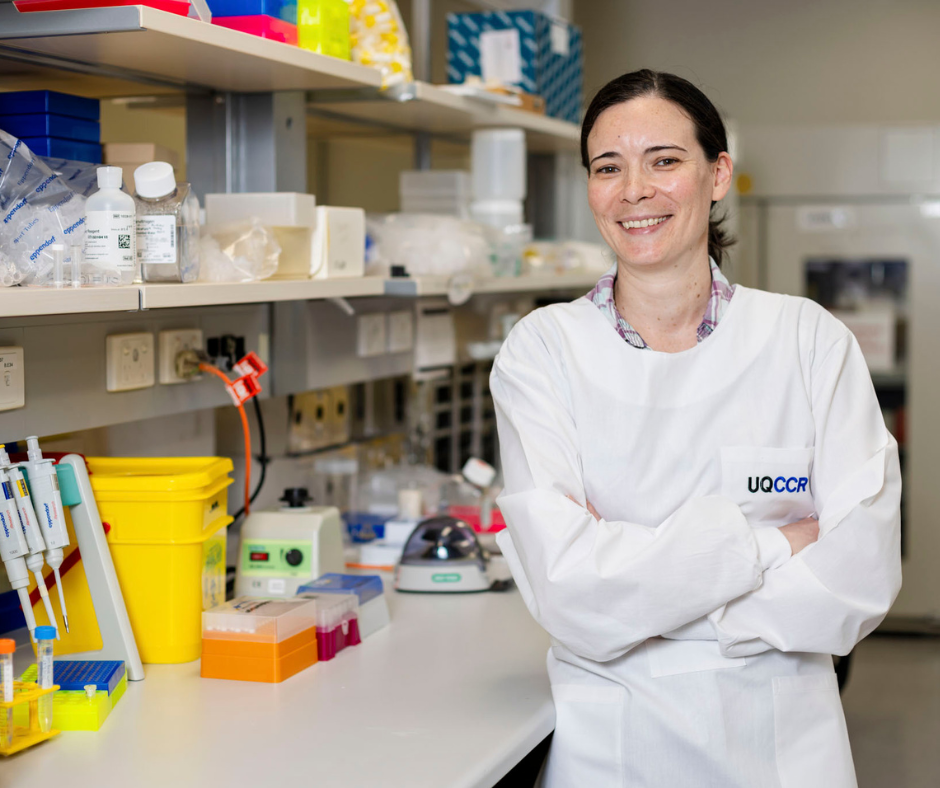
Cherish funds Dr Eva Baxter, the first Research Fellow on the feMMe studies.
After finishing her PhD in biomedical sciences at the University of Edinburgh, Eva decided to work in Brisbane. She heard about QCGC Research’s endometrial cancer studies. She leapt at the opportunity to work in such an under-researched field.
Initially, Eva took on a part-time, three-month contract space to analyse tissue samples using borrowed laboratory space. Her leap of faith has paid dividends. In 2022, Cherish started supporting Eva, enabling feMMe Molecular to expand and establish a dedicated laboratory.
“feMMe has transformed how we approach clinical studies. Now, they all include molecular analysis,” Eva said. “Collecting blood and tumour samples has become the norm because it offers rich research data to personalise treatments for women with gynaecological cancer.”
Today, Eva is dedicated full-time to feMMe Molecular and aiming for the sky.
“In feMMe, 60% of women responded well to the non-surgical treatment, but we could not predict who would benefit. In feMMe Molecular, we analyse the feMMe blood and tumour samples to determine which women will respond and which will not.
“Early in feMMe Molecular, we got a clear signal that women whose endometrial cancer is missing a particular protein or set of proteins, referred to as Mismatch Repair deficiency, do not benefit from the non-invasive treatment. Since identifying this, we are running a new clinical trial (SATELLITE) to offer these patients a new immunotherapy treatment.
“Ultimately, we want to reach a point where if you’re diagnosed with endometrial cancer, you can do a blood test or a biopsy, and the doctors can present you with a range of personalised treatment options, so you make an informed choice based on evidence.”
“feMMe has transformed how we approach clinical studies.”
Your impact
Supporting clinical research is a gift to the future – an enduring statement of your values.
When you plant a tree, you don’t expect to enjoy the shade or eat the tree’s fruit immediately. It takes many years for the tree to grow and provide. Likewise, gynaecological cancer research is unlikely to benefit women today. Yet, with your support, in the future, it will deliver personalised treatment for women with endometrial cancer, adding years to her life and life to her years.
Clinical trials take many years to progress from initial discovery to clinical practice. The feMMe trial was open for patient recruitment for eight years, with follow-up continuing. feMMe evolved into feMMe Molecular and then into the SATELLITE Study. This new study will test immunotherapy as an alternative treatment for women with early-stage endometrial cancer who do not want to undergo a hysterectomy but are unlikely to be treated successfully with the Mirena IUD). The research team expects to uncover many more results that will branch off into new studies in the coming years, each expanding the shade, i.e. improving outcomes for women with endometrial cancer and their families worldwide.
Seed funding from Cherish kicked off feMMe. Since then, the project team has secured a $740,000 National Health and Medical Research Council (NHMRC) grant to fund two projects, feMMe Molecular and the development of a personalised decision-making tool. Cherish is a financial partner on the NHMRC Grant, and other partners are making in-kind contributions. This grant will only take the project so far; further funding is required to translate their findings into practice.
“Someone’s sitting in the shade today because someone planted a tree a long time ago.” — Warren Buffett
Why Cherish?
“feMMe was only the beginning, and we have come a long way with community support, but we’re a long way from finished. When we deliver personalised treatment for all women with endometrial cancer, we’ll be getting close. When we can prevent or cure it, we have other gynaecological cancers to conquer.” Dr Eva Baxter
From humble beginnings in Queensland, Cherish Women’s Cancer Foundation is now a national charity. Cherish exists to fund research into all types of gynaecological cancer and raise awareness that saves and enhances women’s lives. Cherish supports early clinical research, helping to fund small, innovative projects that otherwise would not get funding.
For over a decade, Cherish has partnered with the Queensland Centre for Gynaecological Cancer (QCGC) Research to accelerate clinical trials with the potential to transform how doctors treat women with gynaecological cancer.
Add years to her life and life to her years with Cherish.


Cherish Women’s Cancer Foundation © 2026 | Developed by